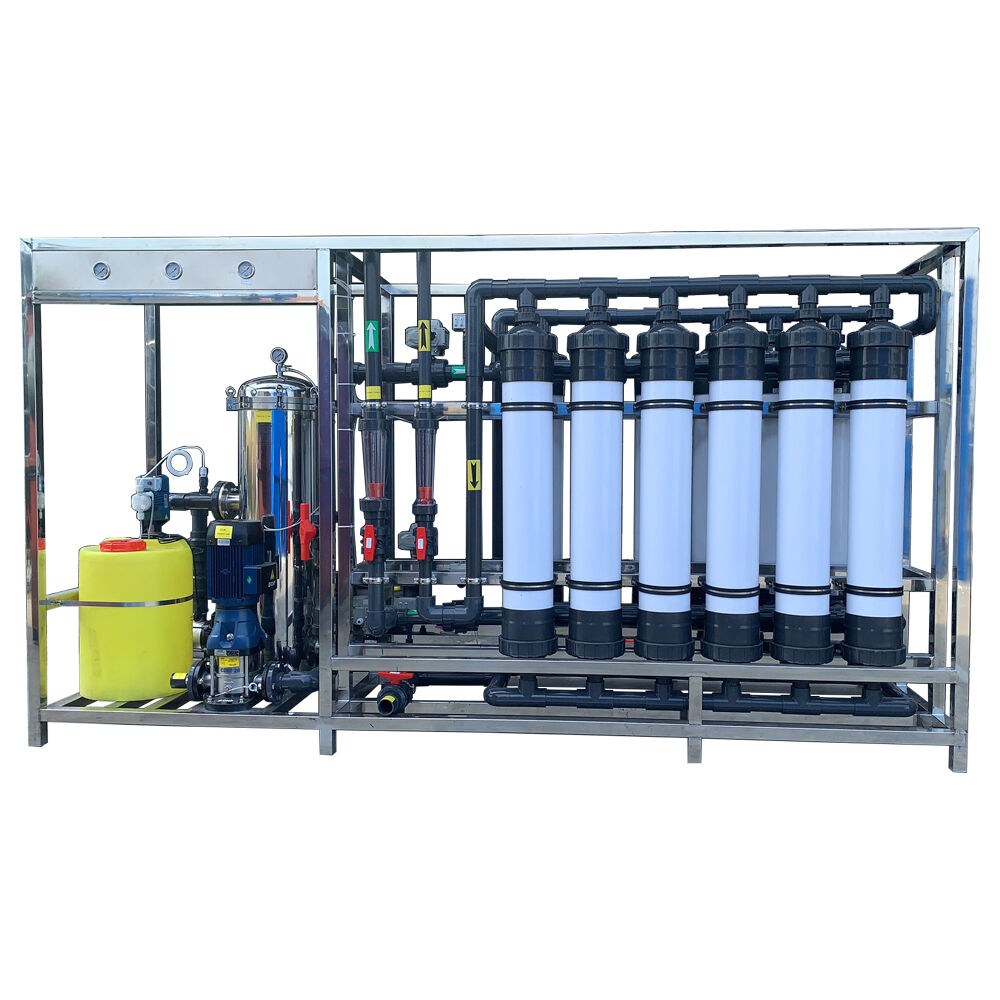
The mechanism of eliminating bacteria and particles in water by Ultrafiltration System.
Pollutants of natural water and industrial wastewater include bacteria, suspended solids and colloids which contributes to high threats to drinking water quality and industrial production. Ultrafiltration (UF) systems are one of the core technologies of membrane separation; this has made them the choice of eliminating these pollutants since they are highly efficient and reliable. Guangzhou VOCEE Membrane Technology is a professional enterprise that is involved in the integration of R and D, manufacturing and sales of membrane separation products which provides high-performance UF systems with different water treatment applications. In this article, we’ll address the principle of the main benefits of UF systems in bacteria and particle removal.
Basic Process: Filtration and Interception of Ultrafiltration Membranes.
The basic mechanism of UF systems of eliminating bacteria and particles is the narrow filtering effects of ultrafiltration membranes. UF systems at VOCEE use hollow fiber, or ceramic ultrafiltration membranes, whose pore size is between 0.01 and 0.1 micrometers which is significantly smaller than the size of most bacteria (0.2 to 2 micrometers) and suspended particles (typically larger than 0.1 micrometers). Under moderate hydrostatic pressure (0.1-0.5 MPa), molecules of water and small-molecular-weight substances enter the membrane pores, and bacteria, algae, sediment, and colloidal particles are physically blocked on the membrane surface. This sieving process is independent of the density or shape of pollutants as opposed to the conventional filtration processes, which makes its removal efficiency consistently high at above 99.9 percent of bacteria and suspended solids.
Removal Efficacy Auxiliary Mechanisms.
Besides physical sieving, the UF systems are also dependent on supplementary mechanisms supportive of additional bacteria and particles removal. The UF products of VOCEE have a special coating of anti-fouling on their membrane surface, creating weak electrostatic repulsions to negatively charged colloids and bacterial cells, and the bacteria and colloidal particles have no ability to adsorb onto the membrane surface. In the meantime, the cross-flow filtration plan of the system constructs a turbulent flow within the surface of the membrane sweeping the trapped pollutants away as they are required. Not only does this prevent membrane fouling, but also increases the likelihood of contact between the pollutants and the membrane, which also elevates the rate of removal of fine particles, bacteria that are near to the membrane pore size.
Some of the important benefits of UF Systems in purification of pollutants.
The UF systems are seen to be more advantageous in bacteria and particle removal as compared to traditional water treatment methods (e.g., sand filtration, coagulation sedimentation, etc.). On the other hand, they are deeply purified and no chemical substances are introduced and does not cause secondary pollution that preserves useful minerals in water (in particular, in the treatment of drinking water). Second, the modular construction permits some flexibility in increasing or decreasing treatment capacity to meet small scale domestic water purification requirements and large scale industrial water treatment requirements. Thirdly, the operation is easy and stable with automatic monitoring and cleaning processes and this lowers the maintenance costs incurred manually. The UF systems of VOCEE, especially, have long membrane service life (3-5 years in case of normal operation) owing to the high quality of membrane materials, as well as owing to sophisticated manufacturing techniques.
The UF Systems of VOCEE are typically applied in the following situations.
The UF systems produced by VOCEE have wide applications where bacteria and particle removal have to be efficient. They are utilized in drinking water treatment to treat surface and ground water and eliminate pathogenic bacteria (e.g. E. coli), and also turbidity-causing particles, so that by the time water passes the drinking water limit it is treated and safe to drink. They can be used in pretreatment of reverse osmosis (RO) systems in industrial water treatment to eliminate suspended solids and bacteria to prevent fouling of RO membranes. They are also employed in recycling of wastewater in the process of clarifying industrial wastewater; the solid particles and bacteria are removed in such a process allowing water to be reused and to save wastage of water resources.
Ultrafiltration systems are based on the fine filters and support mechanisms to remove bacteria and particles in the water effectively and this gives a certain-foresight guarantee of safety of the water. VOCEE will go ahead using its technological strength in membrane separation to optimize UF products providing customers in the world with more efficient and stable water purification solutions.
Table of Contents
- The mechanism of eliminating bacteria and particles in water by Ultrafiltration System.
- Basic Process: Filtration and Interception of Ultrafiltration Membranes.
- Removal Efficacy Auxiliary Mechanisms.
- Some of the important benefits of UF Systems in purification of pollutants.
- The UF Systems of VOCEE are typically applied in the following situations.