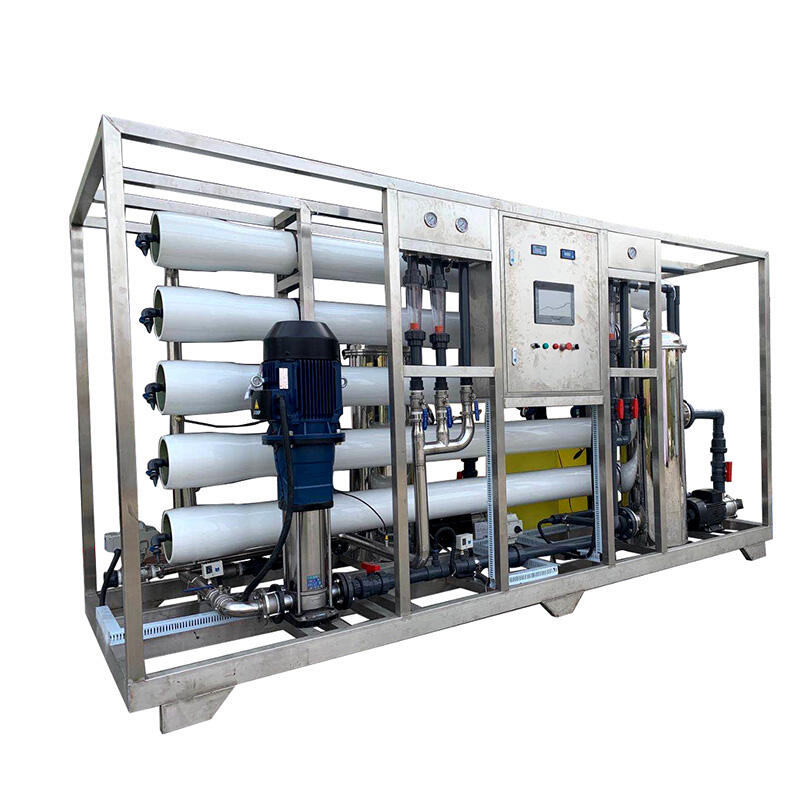
Containerized 120 m³/day RO System for Blueberry Irrigation
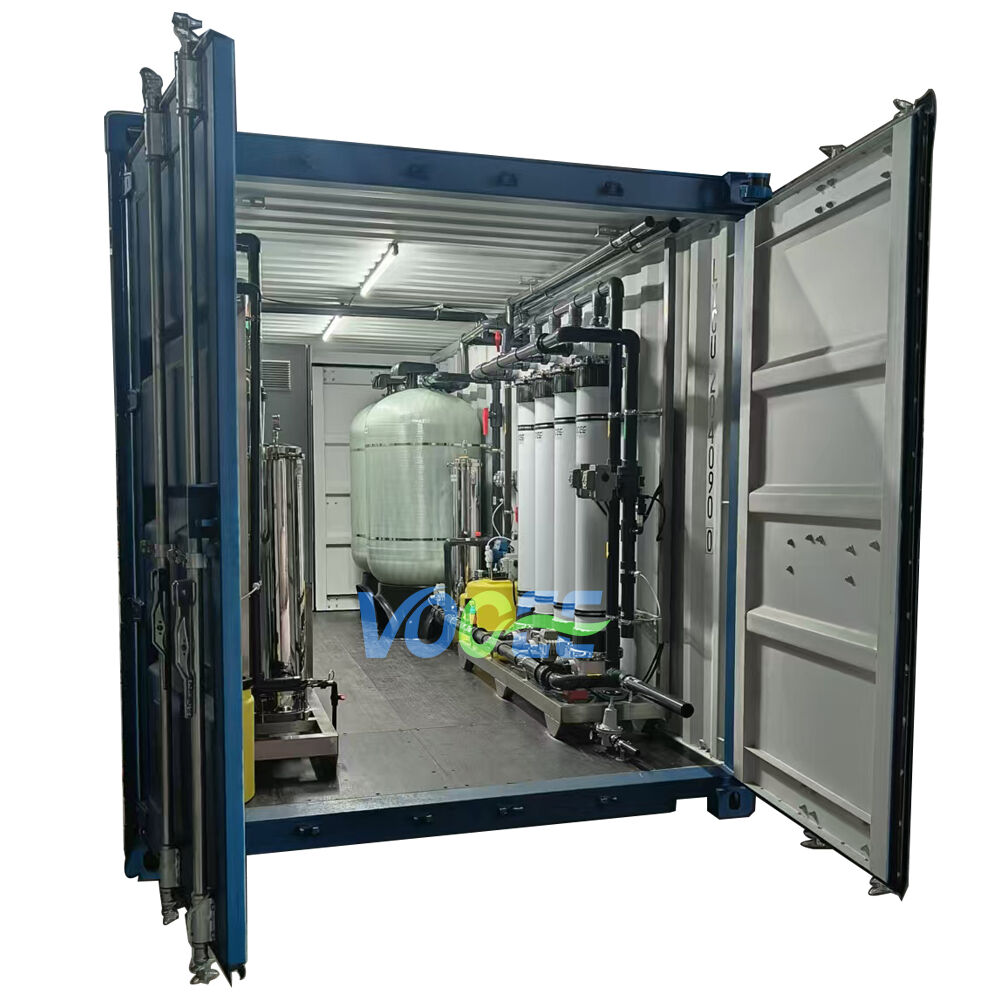
Containerized 120 m³/day Reverse Osmosis System for Blueberry Irrigation
Location: Agricultural Region (Australia)
Water Source: River Water (Surface Water)
Application: Irrigation for Blueberry Plantations
Capacity: 120 m³/day (5 m³/hour over a 24-hour operation)
1. Project Background and Objective
A large-scale blueberry farming operation required a reliable and high-quality water source for irrigation. The only available water source was a nearby river. While abundant, the river water presented several challenges common to surface water sources:
-
High Turbidity: Fluctuating levels of suspended solids, especially after rainfall.
-
Seasonal Organic Load: Presence of algae, bacteria, and decaying plant matter.
-
Microbiological Contamination: Risk of pathogens that could affect the plants or contaminate the fruit.
-
Variable Total Dissolved Solids (TDS): While not as high as brackish water, the salinity needed to be reduced to an optimal level for sensitive crops like blueberries, which are sensitive to high salinity and specific ion toxicities (e.g., sodium and chloride). -
The primary objective was to design and deploy a robust, self-contained, and automated water treatment system that could reliably convert the variable-quality river water into a consistent, high-quality irrigation supply. The system needed to be compact, easy to deploy, and require minimal on-site supervision.
2. Selected Solution: Containerized RO System
To meet these requirements, a 20 ft containerized reverse osmosis system was selected. This modular approach offers several advantages: it is pre-engineered, factory-tested, and arrives on-site as a "plug-and-play" unit, significantly reducing installation time and civil works. -
The treatment train is designed in multiple stages to provide a barrier against each category of contaminant, protecting downstream equipment and ensuring final water quality.
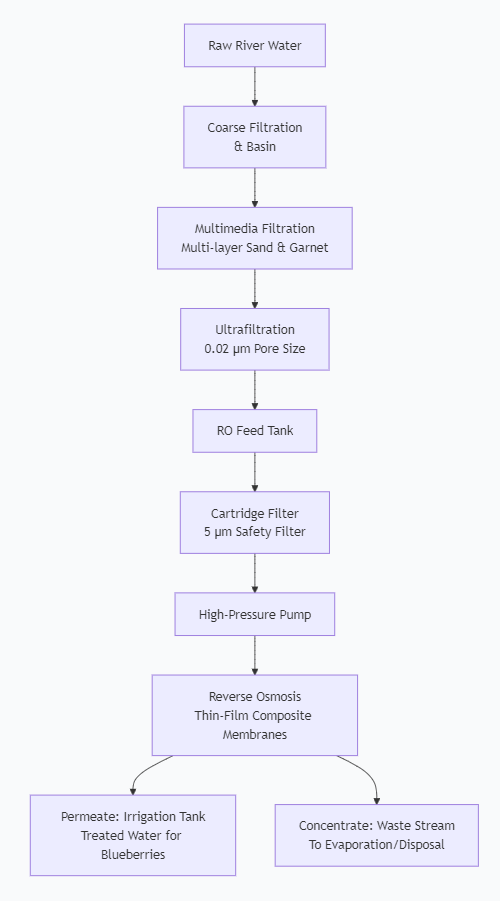
3. Process Flow Diagram
The water treatment process follows this sequence:
4. Detailed System Design and Components
4.1. Pretreatment Stage
Effective pretreatment is critical for the longevity and performance of the downstream RO membranes, especially when treating surface water. -
-
Raw Water Intake & Coarse Filtration: River water is pumped into a settling basin or through a coarse strainer (e.g., 200 microns) to remove large debris, sand, and heavy silt.
-
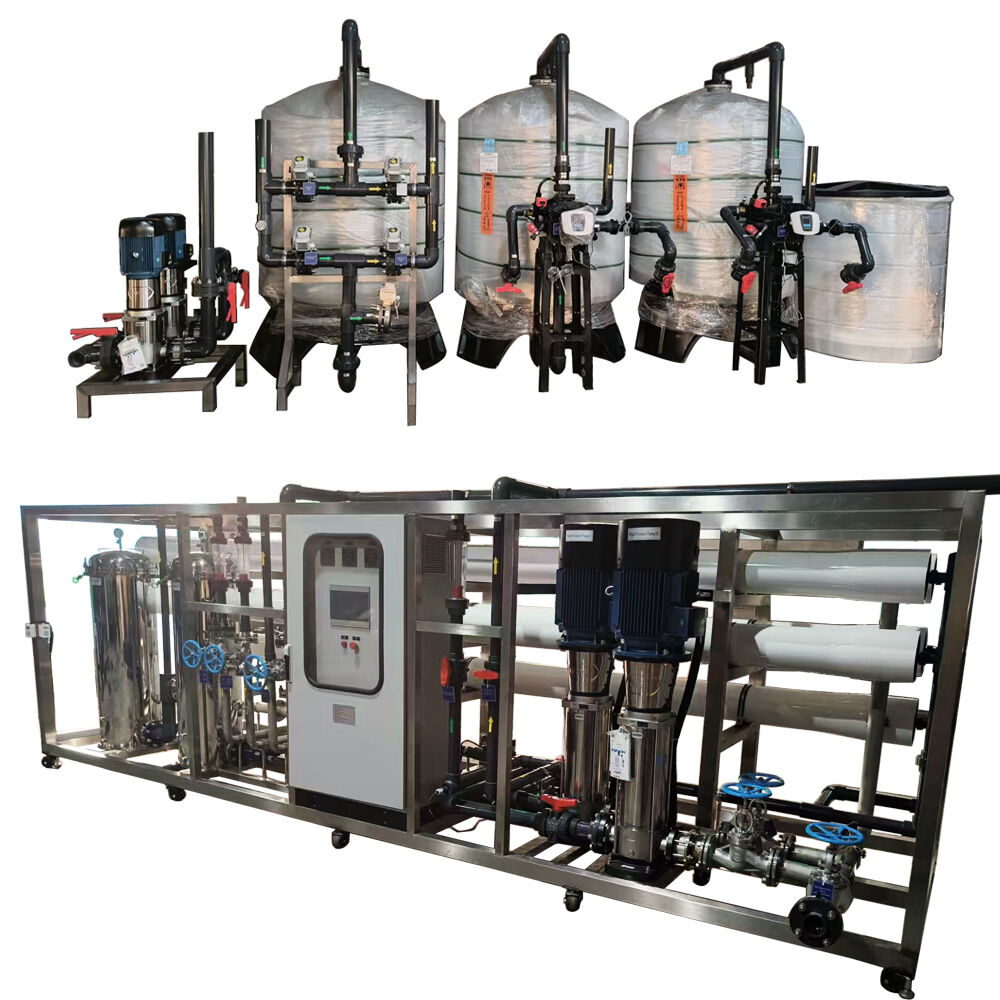
Multimedia Filtration (MMF): Water is then passed through a multimedia filter. This pressure vessel contains layers of graded media, such as anthracite, sand, and garnet. This layer removes a wide range of suspended solids and colloidal matter that cause turbidity, significantly reducing the Silt Density Index (SDI). -
-
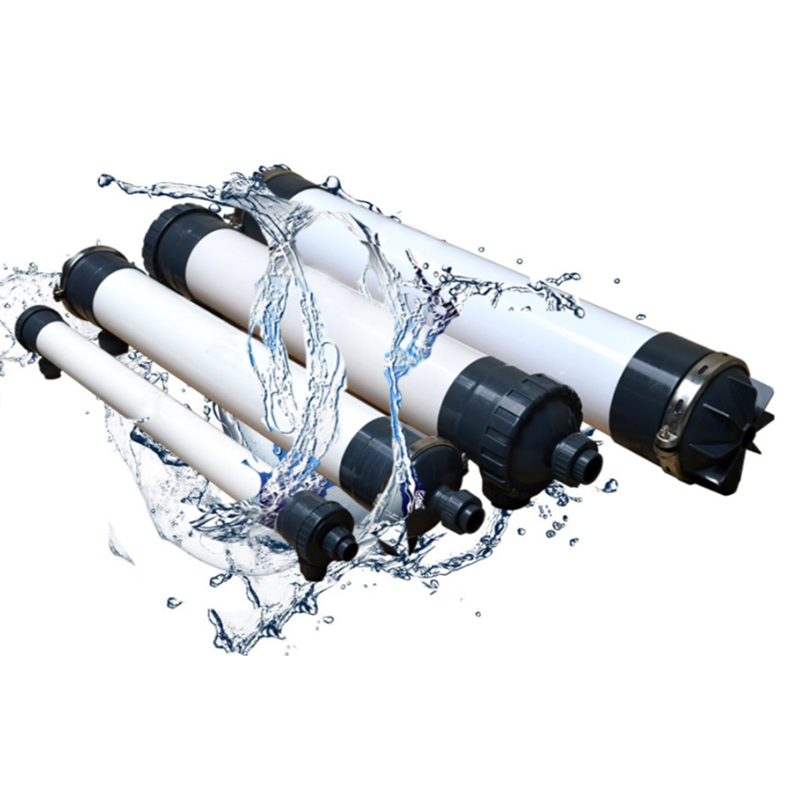
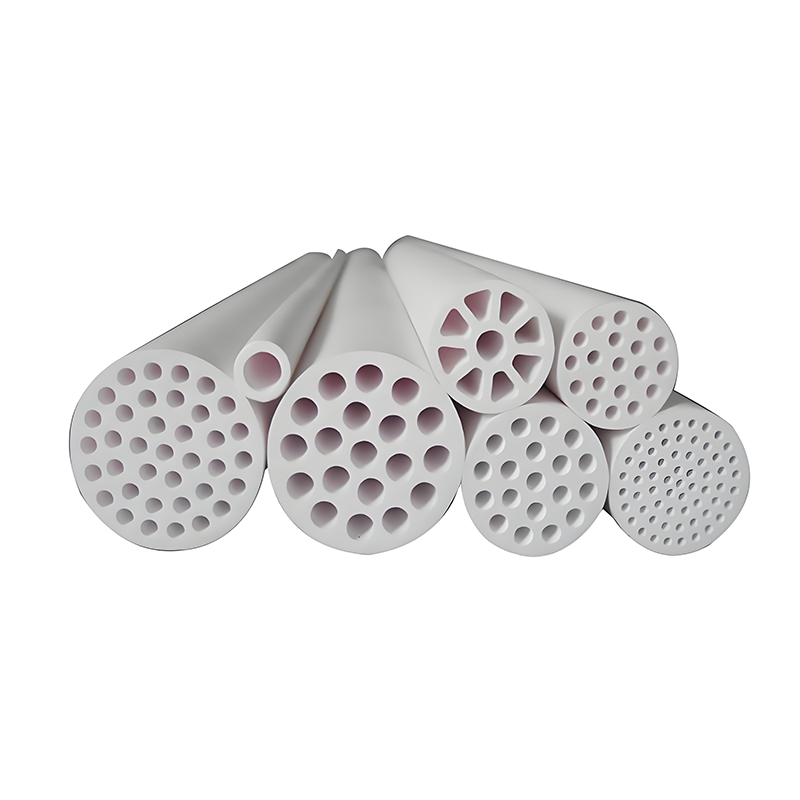
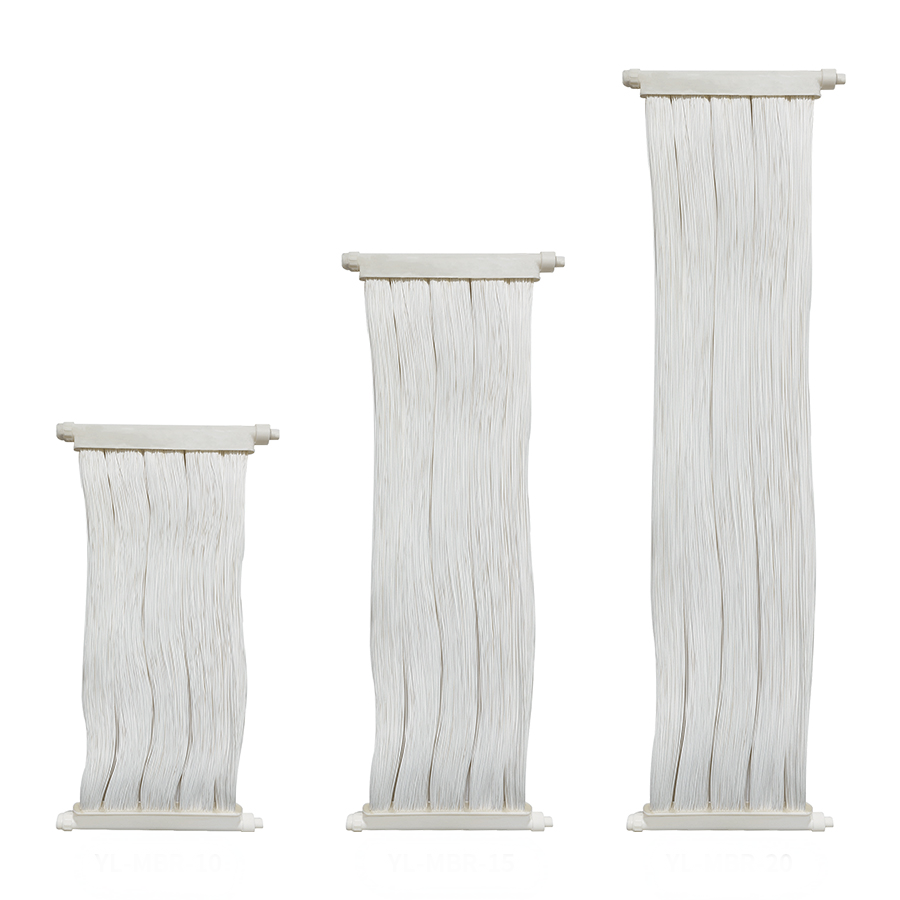
Ultrafiltration (UF): As a polishing step before RO, a UF membrane system (pore size ~0.02 µm) is employed. The UF acts as an absolute barrier to virtually all suspended solids, colloids, bacteria, and most viruses. This step is crucial for protecting the RO membranes from fouling and biofouling.
4.2. Reverse Osmosis Stage
-
RO Feed Tank: Filtered water is stored in an intermediate tank to ensure a consistent supply to the RO system.
-
5 µm Cartridge Filter: Just before the RO membranes, a final safety filter traps any particles that might have been released from the upstream processes, such as broken filter media or pipe scale. -
-
High-Pressure Pump: A multistage centrifugal pump, typically made of stainless steel, pressurizes the feed water to the required operating pressure.
-
Reverse Osmosis Membranes: The heart of the system. The unit is equipped with spiral-wound, thin-film composite polyamide membranes designed for brackish water. These membranes reject up to 99% of dissolved salts, including sodium and chloride ions, as well as other dissolved solids and organic molecules. -
-
Chemical Dosing: To optimize performance, automated dosing systems are integrated:
-
Antiscalant: Injected before the RO to prevent the precipitation of sparingly soluble salts (like calcium carbonate or calcium sulfate) on the membrane surface. --
-
Cleaning in Place (CIP) System: An integral CIP unit allows for periodic chemical cleaning of the membranes to remove foulants and restore performance without dismantling the system.
-
-
4.3. Control and Monitoring
The system is controlled by a Programmable Logic Controller (PLC) with a Human-Machine Interface (HMI) touchscreen. This automates all functions, including:
-
Start-up and shut-down sequences.
-
Backwashing of the multimedia and UF filters.
-
Monitoring of key parameters: flow rates (feed, permeate, concentrate), pressures, conductivity (feed, permeate), pH, and temperature.
-
Remote monitoring capabilities (e.g., via 4G/SCADA) allow operators to check system status and receive alarms on mobile devices, ensuring rapid response to any issues.
5. System Performance and Water Quality
Parameter Raw River Water (Typical) After Pretreatment (UF) Final RO Permeate Blueberry Irrigation Target Turbidity (NTU) 10 - 50 < 0.1 < 0.1 < 1.0 SDI (Silt Density Index) > 6 (High) < 3 < 1 < 3 TDS (ppm) 300 - 800 300 - 800 < 30 - 50 < 100 - 200 Bacteria & Viruses Present > 99.99% Removal > 99.99% Removal Free from Pathogens Sodium (Na+) Variable Variable > 95% Rejection Low (Critical for Berries) Chloride (Cl-) Variable Variable > 95% Rejection Low (Critical for Berries) The system achieves a recovery rate of approximately 60-70% , producing 5 m³/hour of high-quality permeate. The resulting water is virtually free of suspended solids, has a very low microbial count, and possesses a consistently low salinity level. This water is ideal for sensitive crops like blueberries, as it minimizes the risk of salt burn, promotes healthy root development, and allows for precise control over fertigation (the application of fertilizers through the irrigation system).
6. Key Advantages for the Client
-
Guaranteed Crop Health: By removing harmful salts and pathogens, the system directly contributes to higher yields and better-quality fruit.
-
Operational Independence: The farm is no longer dependent on inconsistent rainfall or shared, potentially contaminated, irrigation channels.
-
Plug-and-Play Deployment: The containerized design meant the system was operational within days of delivery, with minimal site preparation.
-
Automated and Low-Maintenance: Automated backwashing and CIP cycles, along with remote monitoring, reduce the need for constant on-site operator attention.
-
Scalability: The modular nature allows for additional units to be easily added if the farm expands or water demand increases.
7. Conclusion
The deployment of the 120 m³/day containerized reverse osmosis system has provided a robust and sustainable solution to the farm's water challenges. By transforming a variable and potentially harmful river source into a consistent, high-quality irrigation supply, the system has de-risked the agricultural operation and created the optimal conditions for growing high-value blueberry crops. This case study demonstrates the effectiveness of combining multimedia filtration, ultrafiltration, and reverse osmosis in a mobile, containerized format for advanced agricultural applications.
-
-